BTT chapter guide
BTT road signs and markings explained
58 BTT practice questions in this chapter · unofficial practice, not the official question bank
Signs and markings are the largest group of BTT questions in our bank, because the BTT is where you first have to read Singapore's roads at a glance. This chapter covers the lines along the kerb (single and double yellow lines, yellow and white zig-zags), the lines down the middle of the road, bus lanes and yellow boxes, traffic lights including arrows and a flashing amber, and road signs shown as pictures.
For the sign pictures, learn the families before the individual signs: circles give orders, most warning signs are triangles, and rectangles give information, with orange used for work zones. Then the less common BTT signs, such as those for school zones, speed limits ending and tunnel signals, are easier to place. The sample questions below are mostly ones that appear only in the BTT set.
Sample questions, explained
12 of the 58 questions in this chapter, with the reasoning behind each answer.
-
1. You are on a side road and reach a pair of broken white lines painted across your lane at the junction. What do they tell you?
- AYou have priority over traffic on the main road
- BStop completely, even if the main road is clear
- CGive way to traffic on the major road (correct answer)
- DPedestrians may cross here at any time
Why: Parallel broken white lines across the road are a give-way marking. Slow down and let main-road traffic pass, stopping only if you need to. A single solid line across the road, usually with a stop sign, requires a full stop.
-
2. You see this sign at the start of a road. What does it mean?

- AOne-way road ahead, enter with care
- BNo parking at any time
- CRoad closed to lorries only
- DNo entry for all vehicles (correct answer)
Why: This prohibitory sign bars every vehicle from entering the road beyond it. Ignoring a prohibitory sign is an offence.
-
3. You see this sign at a junction. What does it mean?
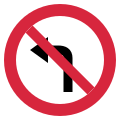
- AYou must not turn left (correct answer)
- BYou must turn left
- CThe left lane is closed ahead
- DThere is a sharp bend to the left
Why: This prohibitory sign bans turning left at that point. Disobeying a prohibitory sign is an offence.
-
4. You are approaching a junction and see this sign. What does it mean?
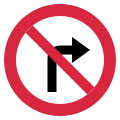
- AYou must turn right ahead
- BRight turns are allowed only for buses
- CGive way to traffic turning right
- DYou must not turn right (correct answer)
Why: This prohibitory sign bans right turns at that point. Find another route or a junction where turning right is allowed.
-
5. What does this sign mean for your speed?
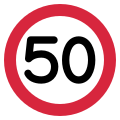
- AThe recommended speed is 50 km/h
- BDo not drive faster than 50 km/h (correct answer)
- CYou must drive at least 50 km/h
- DThe road ends in 50 metres
Why: A number inside a red ring is a speed limit sign, which sets the maximum speed allowed. Exceeding it is an offence.
-
6. You are driving at 75 km/h as you pass this sign. What should you do?
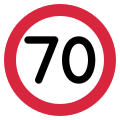
- ASlow down to 70 km/h or less (correct answer)
- BKeep to 75 km/h, as you are within 10% of the sign
- CSpeed up to clear the stretch quickly
- DNothing, because the sign applies only to lorries
Why: This speed limit sign means do not exceed 70 km/h. At 75 km/h you are over the limit, so you must slow down.
-
7. What does this sign require you to do?

- AKeep left; this is a compulsory instruction (correct answer)
- BKeeping left is advised but optional
- CThe left lane is closed, so move right
- DNo left turn
Why: This is a mandatory sign, and mandatory signs are compulsory. Disobeying one is an offence.
-
8. What instruction does this sign give?
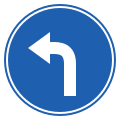
- ANo left turn ahead
- BBend to the left ahead; slow down
- CThe road ahead ends on the left
- DTurn left ahead (correct answer)
Why: This is a mandatory sign telling you that you must turn left ahead. Mandatory signs give orders, so failing to follow one is an offence.
-
9. What does this sign warn you about?
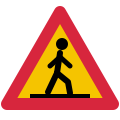
- AAn overhead bridge for pedestrians ahead
- BA pedestrian crossing ahead; slow down and be ready to stop for people crossing (correct answer)
- CThe footpath ends, so pedestrians will walk on the road
- DPedestrians are banned from the road ahead
Why: This warning sign tells you a designated pedestrian crossing is coming up. Slow down so you can stop for anyone using it.
-
10. You pass this sign near a school. What should you do?
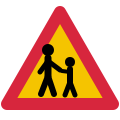
- ASlow down and look out for children crossing the road (correct answer)
- BSound your horn to warn the children
- CSpeed up to clear the area quickly
- DStop and wait until a crossing warden waves you on
Why: This warning sign alerts you to children who may be walking or crossing the road ahead. Reduce speed so you can react if a child steps out.
-
11. What does this warning sign tell you about the road ahead?
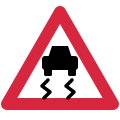
- AThe road surface ahead is uneven
- BA series of sharp bends ahead
- CThe road may be slippery; slow down and drive carefully (correct answer)
- DAn accident blackspot where you must use hazard lights
Why: This warning sign tells you grip may be poor ahead. Lower your speed and avoid sudden braking or steering.
-
12. You see this sign on your route. What does it warn you about?
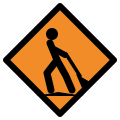
- AA pedestrian-only zone ahead
- BRoad works ahead; slow down and watch for work activity (correct answer)
- CWorkers ahead, so sound your horn as you pass
- DThe road ahead is closed and you must turn back
Why: This sign warns of road works. Slow down, drive carefully and keep alert for workers, equipment and changes in the lanes.
Practise all 58 BTT road signs & markings questions
Unofficial practice questions written by coeprice.com. We are not affiliated with the Singapore Police Force, the LTA or any driving centre. Study the official handbook for your test.

Practise offline in the app
Steer SG for Android keeps your progress, runs full BTT, FTT and RTT mock exams, and has every question in English, 中文, Melayu and தமிழ். The official handbooks save offline too. Free, no ads.
Theory practice is on Android now, iPhone update coming soon. Unofficial practice app. Not affiliated with the Singapore Police Force (SPF) or the LTA.
Keep going
More BTT chapters
Explore COE Data
By Category