Road Signs & Markings
59 practice questions for the BTT & FTT
Most Basic Theory Test questions on signs and markings come down to one skill: reading the road surface and kerb correctly at a glance. In Singapore the colour and pattern of a line tells you a great deal. Yellow lines along the kerb control parking and stopping, white lines in the middle of the road control crossing and overtaking, and zig-zags warn you that something important is just ahead.
The details are where candidates lose marks. A single yellow line restricts parking only during set hours, while double yellow lines and yellow zig-zags apply at all times, and double zig-zags ban even a quick drop-off. Bus lanes come in two flavours with different operating hours, and a yellow box junction has a short list of situations in which you may wait inside it.
Traffic light questions also sit here: what amber really requires, what a flashing amber means, and how red and green arrows interact. Work through these questions until you can explain why each wrong option is wrong, not just pick the right one.
Road Signs & Markings quiz
Unofficial practice questions written by coeprice.com. We are not affiliated with the Singapore Police Force, the LTA or any driving centre. Study the official handbook for your test. Read the official BTT handbook › Read the official FTT handbook ›

Practise offline in the app
Steer SG for Android keeps your progress, runs full BTT, FTT and RTT mock exams, and has every question in English, 中文, Melayu and தமிழ். The official handbooks save offline too. Free, no ads.
Theory practice is on Android now, iPhone update coming soon. Unofficial practice app. Not affiliated with the Singapore Police Force (SPF) or the LTA.
All road signs & markings questions and answers
-
A single unbroken yellow line runs along the kerb beside you. When may you NOT park there?
Show answer
Between 7am and 7pm, except on Sundays and public holidays
A single yellow line is a time-limited restriction: no parking from 7am to 7pm, but it does not apply on Sundays and public holidays. Lines that apply around the clock are doubled or zig-zagged.
-
What do two parallel unbroken yellow lines along the side of the road mean?
Show answer
No parking at any time, but you may stop briefly to pick up or set down passengers
Double yellow lines ban parking at all hours on that side of the road. A brief stop to let someone in or out is still allowed, which is what separates them from double zig-zag lines.
-
You see double yellow zig-zag lines along the kerb. What is the rule?
Show answer
No stopping at any time on that side of the road
Double yellow zig-zags are the strictest kerb marking: you may not stop there at all, even for a moment. Breaking this rule carries demerit points as well as a fine.
-
How does a single yellow zig-zag line differ from double yellow zig-zag lines?
Show answer
A single zig-zag bans parking at all times but still allows an immediate pick-up or drop-off
A single yellow zig-zag means no parking at any time, though you may stop just long enough to let passengers in or out. Doubling the zig-zag removes that allowance and bans stopping altogether.
-
White zig-zag lines are painted along the edge of the road ahead. What do they warn you about?
Show answer
A pedestrian crossing is ahead; do not stop, wait or overtake in the zig-zag area
White zig-zags give advance warning of a pedestrian crossing. Within them you must not stop, wait or overtake, and pedestrians are not supposed to cross on the zig-zag section itself.
-
You are going straight on at a yellow box junction. Your light is green, but traffic beyond the box has stopped. What should you do?
Show answer
Wait behind the stop line until there is room to clear the box completely
Entering a yellow box and causing an obstruction is an offence even on a green light. If your exit is blocked, stay behind the line until you can drive straight through.
-
In which situation may you wait inside a yellow box junction?
Show answer
When you are turning right and are held up only by oncoming traffic
Turning vehicles may wait in the box for a gap in oncoming traffic, or for pedestrians to finish crossing, because they will not block cross traffic. If the light turns red while you wait, complete the turn and clear the box.
-
A lane is marked with a single continuous yellow line (a normal bus lane). When may cars NOT drive in it?
Show answer
Weekdays 7.30am to 9.30am and 5pm to 8pm, excluding weekends and public holidays
A normal bus lane operates on weekday mornings and evenings only. Outside those hours, and wherever the yellow line is broken to let you turn into or out of a side road, other vehicles may use it.
-
How can you tell that a bus lane is a full-day bus lane?
Show answer
A red line runs alongside the yellow line
A red line parallel to the yellow line marks a full-day bus lane. Its restriction runs from 7.30am to 11pm, Monday to Saturday, and does not apply on Sundays and public holidays.
-
Unbroken double white lines run down the centre of a two-way road. Which of these is allowed?
Show answer
Overtaking, provided you stay entirely to the left of the lines
You must never cross double white lines, so right turns and U-turns over them are banned, and parking is prohibited on both sides. You may pass another vehicle only if you can do it without crossing the lines.
-
You are on a side road and reach a pair of broken white lines painted across your lane at the junction. What do they tell you?
Show answer
Give way to traffic on the major road
Parallel broken white lines across the road are a give-way marking. Slow down and let main-road traffic pass, stopping only if you need to. A single solid line across the road, usually with a stop sign, requires a full stop.
-
The traffic lights at a junction are showing a flashing amber light. What does it mean?
Show answer
The signals are faulty; proceed with care and give way to traffic from the right
A flashing amber means the signals are out of order. Treat the junction with extra caution and give way to traffic approaching from your right.
-
You want to turn right. The main signal is green, but a red arrow pointing right is lit, and there is no oncoming traffic. What should you do?
Show answer
Stay behind the stop line until the red arrow goes off
A red arrow means stop for that direction regardless of the other signals. You must wait behind the stop line even if the road ahead looks clear.
-
What does an area of white chevron markings on the road surface mean?
Show answer
It channels traffic, so you must not drive or park on it
Chevron areas guide traffic into the correct paths. They are not lanes or parking spaces, so keep off them.
-
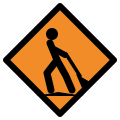
You see diamond-shaped signs with a black symbol on an orange background. What are they?
Show answer
Warning signs for a work zone
Work zone signs are orange with black symbols or text. Diamond-shaped ones warn of a hazard and rectangular ones give information. Obey any temporary speed limit posted in the work zone.
-
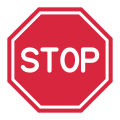
You see this sign at a junction. What must you do?
Show answer
Stop before the white line and give way to traffic from both the right and the left
A stop sign needs a full stop at the white line every time, even when the junction looks empty. Move off only after letting traffic from either side go first.
-
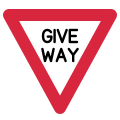
What does this sign tell you to do?
Show answer
Slow down and give way to traffic on the major road, stopping only if you need to
The give-way sign asks you to let traffic on the major road pass first. Unlike a stop sign, you only have to stop if that traffic makes it necessary.
-
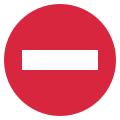
You see this sign at the start of a road. What does it mean?
Show answer
No entry for all vehicles
This prohibitory sign bars every vehicle from entering the road beyond it. Ignoring a prohibitory sign is an offence.
-
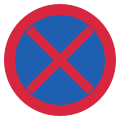
This sign is posted along a stretch of road. What does it mean?
Show answer
No stopping
This is the no-stopping sign, so you must not stop your vehicle in the zone it covers. It is stricter than the no-waiting sign, which still lets passengers board or alight.
-
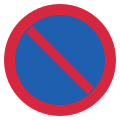
What does this sign by the kerb mean?
Show answer
No waiting: you may stop only to let passengers board or alight
This is the no-waiting sign. Your vehicle must not wait there, but a brief stop just long enough for passengers to get in or out is allowed.
-
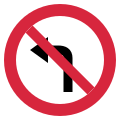
You see this sign at a junction. What does it mean?
Show answer
You must not turn left
This prohibitory sign bans turning left at that point. Disobeying a prohibitory sign is an offence.
-
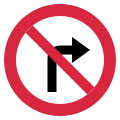
You are approaching a junction and see this sign. What does it mean?
Show answer
You must not turn right
This prohibitory sign bans right turns at that point. Find another route or a junction where turning right is allowed.
-
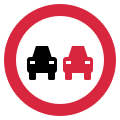
What does this sign mean for the road ahead?
Show answer
No overtaking
This prohibitory sign forbids overtaking on the stretch of road it covers. Stay behind the vehicle in front until the restriction ends.
-
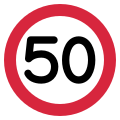
What does this sign mean for your speed?
Show answer
Do not drive faster than 50 km/h
A number inside a red ring is a speed limit sign, which sets the maximum speed allowed. Exceeding it is an offence.
-
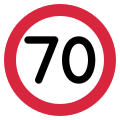
You are driving at 75 km/h as you pass this sign. What should you do?
Show answer
Slow down to 70 km/h or less
This speed limit sign means do not exceed 70 km/h. At 75 km/h you are over the limit, so you must slow down.
-
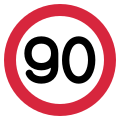
After passing this sign, what is the highest speed you may drive at?
Show answer
90 km/h
This speed limit sign means do not exceed 90 km/h. Vehicles with a lower vehicle speed limit of their own must keep to whichever limit is lower.
-
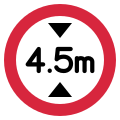
What does this sign mean?
Show answer
Vehicles taller than the height shown must not go past it
This is a height limit sign. It bars any vehicle whose overall height exceeds the figure shown, and the figure can change from place to place.
-
This sign shows a 4.5 m limit. What is the rule for driving a vehicle taller than 4.5 m?
Show answer
It is an offence to drive it without a police escort
Driving a vehicle with an overall height above 4.5 m without a police escort is an offence. Plan the route and apply for an escort before the journey.
-
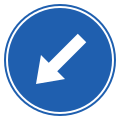
What does this sign require you to do?
Show answer
Keep left; this is a compulsory instruction
This is a mandatory sign, and mandatory signs are compulsory. Disobeying one is an offence.
-
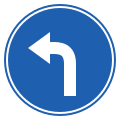
What instruction does this sign give?
Show answer
Turn left ahead
This is a mandatory sign telling you that you must turn left ahead. Mandatory signs give orders, so failing to follow one is an offence.
-
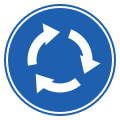
You see this sign as you approach a roundabout. What should you do?
Show answer
Slow down, stop if necessary, and give way to traffic on your right
At a roundabout, traffic from your right has priority. Slow down on the approach and be ready to stop until there is a safe gap.
-
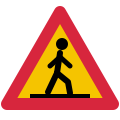
What does this sign warn you about?
Show answer
A pedestrian crossing ahead; slow down and be ready to stop for people crossing
This warning sign tells you a designated pedestrian crossing is coming up. Slow down so you can stop for anyone using it.
-
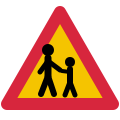
You pass this sign near a school. What should you do?
Show answer
Slow down and look out for children crossing the road
This warning sign alerts you to children who may be walking or crossing the road ahead. Reduce speed so you can react if a child steps out.
-
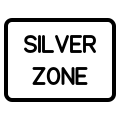
What does this sign at the start of a zone tell you?
Show answer
You are entering an area with many elderly pedestrians; slow down and keep within the posted limit
A Silver Zone is designed to protect elderly pedestrians. Slow down, watch for older people crossing, and do not exceed the speed limit posted with the sign.
-
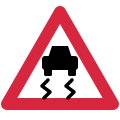
What does this warning sign tell you about the road ahead?
Show answer
The road may be slippery; slow down and drive carefully
This warning sign tells you grip may be poor ahead. Lower your speed and avoid sudden braking or steering.
-
You see this sign on your route. What does it warn you about?
Show answer
Road works ahead; slow down and watch for work activity
This sign warns of road works. Slow down, drive carefully and keep alert for workers, equipment and changes in the lanes.
-
What should you expect after passing this warning sign?
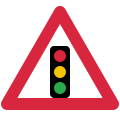
Show answer
Traffic lights ahead; slow down and be ready for them to change
This warning sign tells you there are traffic signals ahead. Slow down so you can stop safely if they change.
-
What hazard does this sign warn you about?
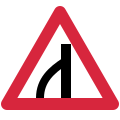
Show answer
Traffic will join your road ahead; slow down and watch for it
This is a merging traffic warning. Slow down and look out for vehicles joining from a side road so they can merge safely.
-
What does this sign tell you about the lanes ahead?
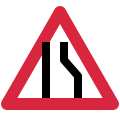
Show answer
Lanes merge ahead; slow down and watch for vehicles moving into your path
This warning sign means the number of lanes is reducing. Slow down and be ready for traffic from the lane that ends to merge with yours.
-
What does this sign mean for the lane it marks?
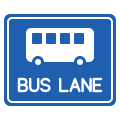
Show answer
Vehicles other than buses may not use the lane during its restricted hours
This sign marks a bus lane. Other vehicles must keep out during the restricted hours, which depend on whether it is a normal or a full-day bus lane.
-
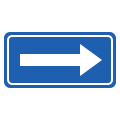
What does this sign mean for traffic on the road?
Show answer
Traffic on this road flows in one direction only
This sign marks one-way traffic. Vehicles may only travel in the direction of the arrow, though they may still turn left or right off the road.
-
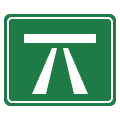
What applies once you pass this sign?
Show answer
The Expressway Rules
This sign marks the start of an expressway. From this point on, vehicles must comply with the Expressway Rules.
-
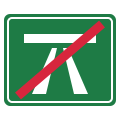
What should you do after passing this sign?
Show answer
Slow down and keep within the speed limit of the road you are joining
This sign marks the end of the expressway. The road beyond usually has a lower speed limit, so reduce speed and keep to it.
-
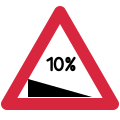
What should you do when you see this sign?
Show answer
Keep left and change to a lower gear; do not overtake, U-turn or park
This sign warns of a steep downward slope. A lower gear lets the engine help hold your speed, and overtaking, U-turns and parking are unsafe on such a slope.
-
Which of these should you NOT do after seeing this sign?
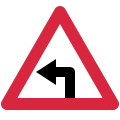
Show answer
Overtake the vehicle in front
This sign warns of a bend to the left. Slow down and keep left, and do not overtake, make a U-turn or park, because your view ahead is limited.
-
A broken white line runs down the centre of a two-way road. What does it mean?
Show answer
Keep to the left of it, and cross it only when the road ahead is clear and it is safe
This line marks the middle of a two-way road. Stay on its left side, and cross it only once you can see that the road ahead is clear and crossing is safe.
-
A single continuous white line marks the centre of a two-way road. Which statement is true?
Show answer
Parking is not allowed on either side of the road at any time
A continuous white centre line also means no parking on either side of the road at all times. You may cross a single white line only when the road ahead is clear and it is safe.
-
Parts of the road surface ahead are painted brick red. What do they tell you?
Show answer
You are in a school zone; slow down and look out for children
Brick-red sections of road mark a school zone. Lower your speed and watch for children on or near the road.
-
A yellow box is painted across the main road at the mouth of a side road. Traffic in the left lane ahead of it has come to a standstill. What should you do?
Show answer
Wait outside the box, keep it clear, and let vehicles from the side road enter the main road
You must not drive into the yellow box when traffic ahead is stationary. Keeping it clear lets vehicles from the side road get onto the main road.
-
You approach a bus stop where the road has a yellow Bus Priority Box with give-way markings, and a bus is waiting to leave the stop. What must you do?
Show answer
Stop before the give-way lines and let the bus pull out
A Bus Priority Box, also called Mandatory Give-Way to Buses, requires you to give way to buses leaving the stop. Stop before the give-way lines and do not stay in the yellow box.
-
Next to a bus stop separator, a chevron area is painted red. What does it mean?
Show answer
You must not drive or park on it, and you should watch for vehicles merging from the bus stop
The red colouring enhances a chevron zone to warn you of vehicles merging from bus stops. As with any chevron area, driving or parking on it is not allowed.
-
Merging arrows are painted on the road ahead, showing two lanes becoming one. Which vehicles have the right of way into the single lane?
Show answer
Vehicles from the two lanes take turns, one from each lane
Merging arrows give advance warning that two lanes are about to become one. Vehicles from the two lanes merge alternately, each taking its turn.
-
You are approaching a zebra crossing. When must you stop?
Show answer
When pedestrians or cyclists are crossing or about to cross
At a zebra crossing you should slow down and stop for anyone crossing or about to cross, including cyclists. Watch the kerbs on both sides as you approach.
-
Which of these may use a bus lane during its operating hours?
Show answer
Bicycles, emergency service vehicles and police vehicles
Apart from buses, only bicycles, emergency service vehicles and police vehicles may use a bus lane during its restricted hours. Other vehicles must stay out.
-
A school bus is travelling in a bus lane during the lane's operating hours. Which statement is correct?
Show answer
It may use the lane but must not stop there to pick up or set down passengers
Non-scheduled buses such as school and factory buses may travel in bus lanes. They are not allowed to stop along the bus lane to pick up or let down passengers.
-
A traffic signal shows a green 'B'. What does it mean?
Show answer
Go for buses only, so they can move off ahead of other traffic
A green 'B' signal lets buses move out of a bus bay or side lane and go ahead of other vehicles. Other drivers must keep to their own signal.
-
The green arrow for your turn starts to flicker before you reach the stop line. What should you do?
Show answer
Stop, because the signal is about to be cancelled
A flickering green arrow means that signal is about to end. If you have not crossed the stop line yet, do not proceed.
-
On a green directional sign, one destination is shown in white text on a blue patch. What does that tell you?
Show answer
That destination is reached by an expressway
On directional signs to expressway destinations, the white text naming an expressway destination is set on a blue background, while the rest of the sign is green.
-
In the KPE or MCE tunnel, an electronic sign shows a speed without a red ring around it. What does that mean?
Show answer
It is a recommended lower speed, shown to smooth traffic during congestion
Variable speed signs in these tunnels show a posted speed limit with a red ring, which you must obey. A figure without the red ring is a recommended speed used in congestion to keep traffic flowing safely.
More topics
Explore COE Data
By Category